
Love Languages
Understanding how you and the people close to you naturally give and receive care. Becoming more intentional about how you show love can transform everyday connection. Couples and relationship coaching online across the UK or in person in Preston, Lancashire.

"How Can I Love You More?"
"Being a DJ, I think in music. The Sasha Mix of M People's 'How can I love you more?' comes to mind here. It is a beautiful piece of music and a beautiful question."
"And I think it is one we should be asking a lot more often, not just to a partner, but to everyone we care about."
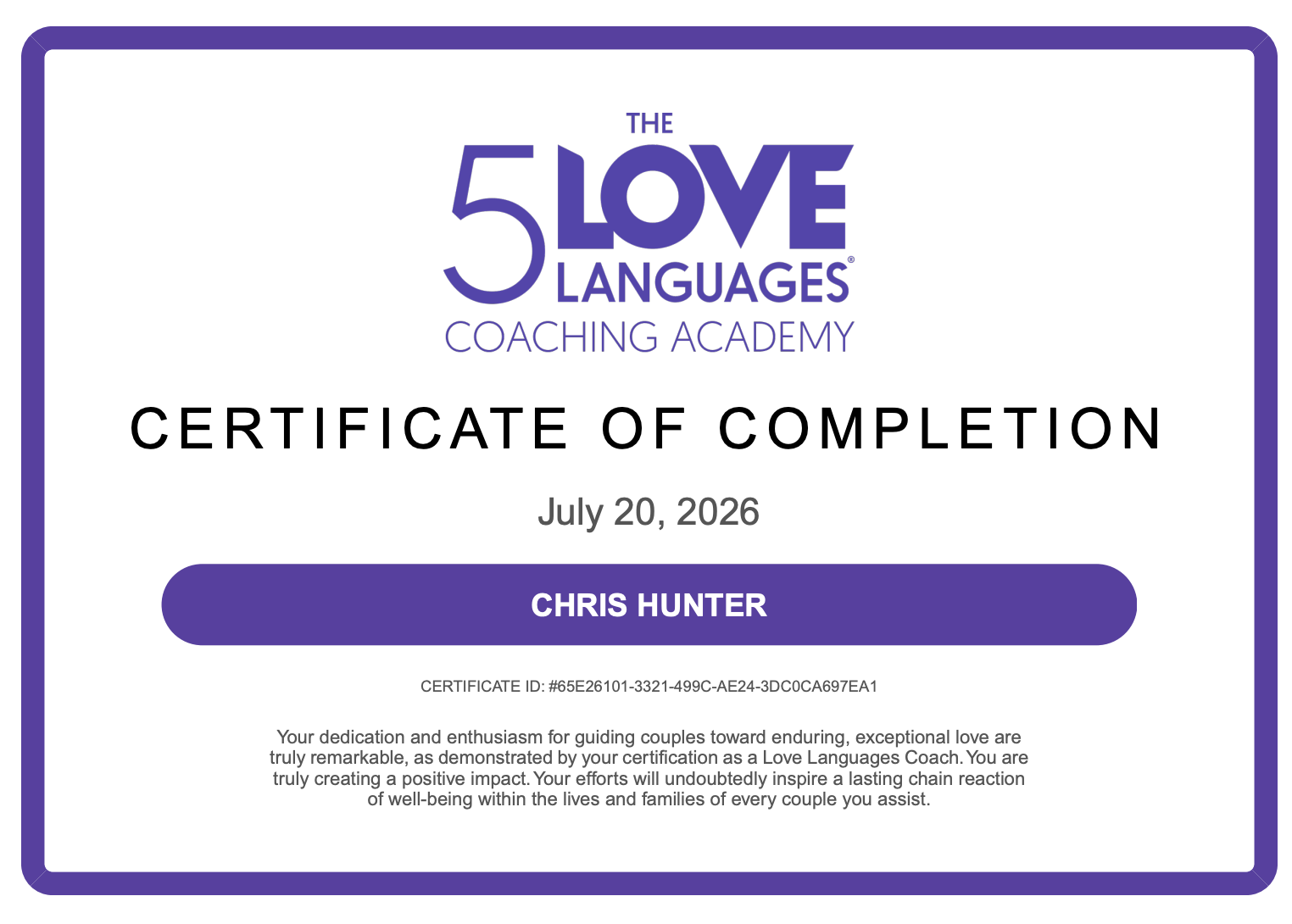 Chris Hunter, Certified 5 Love Languages® Coach
Five ways we give and receive love.
Dr. Gary Chapman named five distinct ways people naturally express and experience care.
Care is felt through practical help freely given, things being done that ease your day or carry part of the load with you.
Care is felt through physical closeness and contact, from a hand on the shoulder or a hug to a reassuring squeeze of the hand.
Care is felt through undivided attention and shared moments without distraction. Being truly present is its own kind of gift.
Care is felt through thoughtful, well-chosen tokens that signal someone was thinking of you. It is the symbolism and thoughtfulness, not the price tag.
Care is felt through what is said: encouragement, appreciation, and honest compliments spoken or written. Words that linger long after the conversation ends.
Love Languages here is a reflective framework for understanding connection. It is not therapy, counselling, or a diagnostic process.
Which love language sounds like you?
Discover your love language
Answer eight quick questions to get a sense of your typical primary love language. This is a light, reflective taster, not a formal assessment.
Love isn't just a language. There are dialects too.
Just as spoken languages have regional variations, love languages have unique personal expressions.
Three stages to love translation.
Start with an initial conversation and complete the Love Language Assessment to uncover your primary languages and unique personal dialects.
Unpack the nuances in your session or premium reports to build a clear, practical map of how you and your loved ones give and receive care.
Apply your shared map in daily life, acting in ways that truly resonate with specific language types for deeper connection and resilience.
How long does it take?
However much time you want to give it.
You can go through your report at your own pace, in your own space, whenever suits you. But the real value comes when you bring what you noticed into a conversation, so once you've had a look, I'd love to walk through it with you and help you work out what it actually means for your life and relationships.
On your own
Around 30 to 60 minutes to read through and let it sink in.
Take your time with it. Your report includes a few reflection questions along the way, so read through your results and jot down whatever surprises you or feels especially true. You don't need everything figured out beforehand, that's what our conversation is for. Come with whatever stood out, even if it's just a gut feeling you can't quite explain yet.
As a couple
Around 30 to 60 minutes each to review your reports individually.
Go through your own results first, on your own, without comparing notes just yet. It's well worth noticing your personal reactions before you see each other's. Once you've both had that space to reflect, we'll sit down together to explore where you naturally align and where you might be missing each other.
As a group
Allow extra time across the group, usually 60 to 90+ minutes.
Group sessions can naturally take longer because more people are involved, for example in a family setting or close-knit team. Everyone reviews their own report first, before we come together to map out the different ways each person expresses and receives care, opening up space for everyone to be heard.
How the sessions work
There's no fixed package here, and no pressure to cover everything in one go. The way it usually works is simple: we book an initial session and see how far through the material we get. Some people and couples get a lot of ground covered in that first hour. Others find there's more worth sitting with than expected, and that's completely normal, especially for couples working through where you overlap and where you differ.
If we don't get through it all, that's not a problem at all, it just means there's more to explore. We can always arrange another session afterward to pick up where we left off. Think of the first session as the start of the conversation, not the whole of it.
The questions in your report are a starting point, not the destination. Whatever you notice on your own is just the beginning, the conversation is where it becomes useful.

On its own, or alongside other modalities, including Belief Coding® and E-Colours.
Love Languages works wonderfully as a standalone conversation for couples, individuals, or families, and it slots neatly alongside the other modalities I offer.
People looking for a shared language, not a verdict.
- Individuals trying to understand why they feel uncared for even when a partner or friend is trying hard.
- Curious individuals wanting to understand how they give and receive care, in relationships, family, or work.
- Individuals looking to understand themselves better, particularly when dating; understanding yourself helps you clearly express your preferences to others, taking some of the guesswork out of building a connection.
- Couples who keep misreading each other's intentions and want a shared vocabulary for connection.
- Couples who aren't necessarily experiencing problems, but simply want to explore their relationship and understand one another on a deeper level.
- Families working through different ways of showing care across generations.
This is reflective coaching, not therapy, medical treatment, or psychological diagnosis. If you are in crisis or need clinical support, please contact a qualified health professional or a local emergency service.
Related notes
Why the compliments we qualify often land as criticism, and how to give your partner words of affirmation that truly land. A relationship coaching perspective.
ReadThe first in a series on the five love languages. We start with physical touch, the only one that's actually biological. A look at oxytocin, Bryan Ferry, and why a hug held a bit longer can reset your whole day.
ReadWhy recurring disagreements are rarely about the surface topic, and how Love Languages and communication lenses help reframe them.
ReadFAQ
Identify and shift limiting beliefs and their origins through guided conversation and gentle cognitive rewiring. Life coaching with Chris Hunter, online or in Preston, Lancashire.
A practical personality awareness framework to understand communication style, reduce friction, and unlock strengths.
Want to talk it through?
The first step is just a conversation. No pressure, no diagnosis, no obligation to book again.
Book a Call