
The Power of Touch: Why a Hug Can Change Your Whole Day
The first in a series on the five love languages. We start with physical touch, the only one that's actually biological. A look at oxytocin, Bryan Ferry, and why a hug held a bit longer can reset your whole day.
This is the first in a series on the five love languages: words of affirmation, quality time, acts of service, gifts, and physical touch. Over the next few weeks and months we'll work through each one, and eventually get into their dialects too.
Most people have never actually heard of the five love languages. It's a simple idea with a big payoff once you know it. It's about the specific way each of us feels most loved, most understood, most seen. And most of us have never sat down and worked out which one is ours.
We're starting with physical touch because it's the only one of the five that isn't just emotional. It's biological. Measurable. Happening in your body right now if someone you trust puts a hand on your shoulder.
And I know for a fact it's mine.
When Something Goes Missing
When my partner and I are apart, even just for a day or two, we both properly notice it. Something's missing, and it's not just 'I miss you' in the abstract. It's a physical thing. Then we see each other again, there's that embrace, that kiss, and something in me just goes 'ahhhhhh... everything is groovy.' Like a switch flipping back to where it's meant to be. I didn't need a book to tell me that's a real response. I've felt it enough times to know.
The Science Bit
Turns out there's a proper reason for that. Kissing, cuddling, skin against skin, even a hug held a beat longer than usual, these aren't just nice moments. They trigger something real. When we experience that kind of touch, our bodies release oxytocin, the bonding hormone. It's the same one released when a mother holds her newborn. It's part of what makes physical closeness feel like coming home rather than just a nice sensation.
Bryan Ferry called one of his best-known tracks 'Love Is the Drug,' and as a title it's not far off. He wasn't singing about brain chemistry, by his own account it was about the buzz of a night out, but the title still lands, because connection genuinely does work a bit like a drug on your system. Oxytocin doesn't just feel nice in the moment either. It's been linked to a real drop in cortisol, the stress hormone, which means touch can literally calm your nervous system down. Lower blood pressure, reduced anxiety, better sleep. Your body isn't being sentimental when it responds to touch like this. It's doing exactly what it evolved to do, telling you you're safe, you're connected, and you're not carrying it all on your own.
Is Touch One of Yours?
So let me ask you something.
Do you feel better after hugging someone? Not just politely better, but properly lighter, like something in your chest has loosened a bit?
And here's the one that usually gets people: have you ever had a shit day, the kind where everything's felt heavy and hard to explain, and someone's put an arm around you, or a hand on your back, without saying a word? No advice, no fixing, just contact. And somehow you knew exactly what that meant, and exactly how much it helped.
If either of those landed, maybe physical touch is one of yours too. Not necessarily the only one, but a real one.
Working Out Your Own
Most people go their whole lives never actually working out what theirs is. They just know some things land and some don't, without ever knowing why.
If you're not sure what yours is, the quickest way to find out is to take our free Love Languages Quiz. A few minutes and you've got a clear picture of your primary language straight away.
Want to go deeper? A personalised premium report explores your full profile, your dialects, and your secondary languages in detail, and includes a section you can share with the people close to you so they know how best to connect with you.
Or if you'd just like to properly understand it rather than guess, drop me a message and let's have a proper conversation about it. No pressure, no pitch, just a chat about what actually makes you feel loved.
We spend a lot of time trying to think our way to feeling better. Sometimes the answer isn't in the head at all. It's in the arms wrapped around someone, in the weight of a hand on your back, in the simple act of two bodies choosing to be close instead of apart.
Love is the drug, whatever Bryan Ferry actually meant by it. So if today's been one of those days, don't underestimate what a hug, held a little longer than usual, might do for you. And don't underestimate what yours might do for someone else.
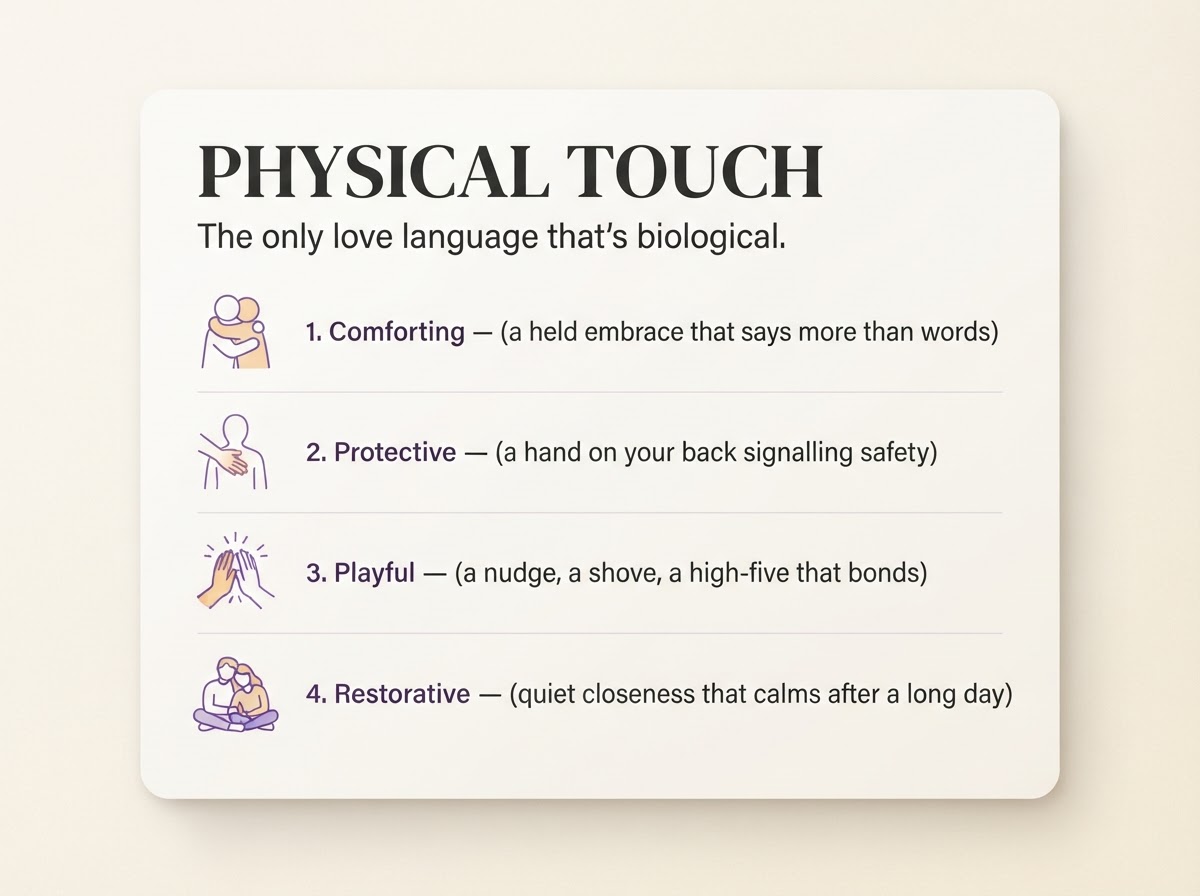
And if physical touch is yours, it's worth knowing it has its own dialects too: a comforting hold, a protective hand on your back, a playful shove, a restorative closeness at the end of a long day. We'll get into those properly in a later post.
This is just the first of the five. In the next post we'll move on to another love language. If you want to make sure you don't miss the rest, subscribe to the newsletter or keep an eye on the blog.
Fancy a chat? Get in touch.
Take our free Love Languages Quiz
Discover your primary love language in just a few minutes, free. Then, if you would like to go deeper, order a personalised premium report for more insight into your own love languages and those of the important people in your life.
Interested in learning more about how Love Languages fits into our reflective coaching process? Read about the full framework on our dedicated page.
Learn more about Love LanguagesThis is reflective coaching, not therapy, medical treatment, or psychological diagnosis. If you are in crisis or need clinical support, please contact a qualified health professional or a local emergency service.
Yes, physical touch is one of the five love languages, alongside words of affirmation, quality time, acts of service, and gifts. For some people it's their primary language; for others it's secondary or less central. Working out which combination is yours is the whole point of exploring Love Languages. This post is the first in a series covering all five.